
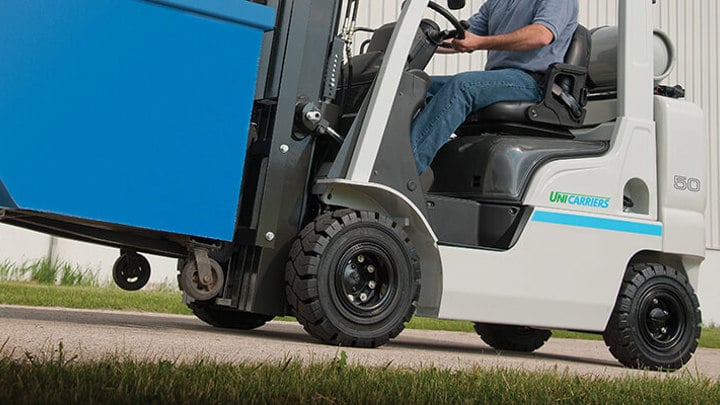
When to Replace Forklift Tires & Choosing the Right Type
Do you think you need new tires on your forklift? Take a look at these tips on choosing the right Type of forklift tire and when you should replace them.
Forklift Tire Selection Factors
- Manufacturer specifications
- Load weight and frequency
- Number of shifts and trips
- Travel distance and speed
- Forklift capacity and class
- Surface conditions (smooth warehouse floors vs. rugged terrain)
- Turning area
- Type and weight of materials moved
- Housekeeping needs (non-marking vs. black compounds)
Nearly all forklift tires fall into two main categories: cushion tires and pneumatic tires.
Cushion Forklift Tires
- Made of smooth solid rubber.
- Ideal for indoor use on concrete or asphalt surfaces.
- Common in warehouses, manufacturing facilities, and distribution centers.
- Lower initial cost and smaller size compared to pneumatic models.
- Lower resale value.
Pneumatic Forklift Tires
- Suitable for indoor and outdoor use on improved surfaces like blacktop or hard-packed dirt.
- Common in lumber yards and construction sites.
- Larger frame and higher initial cost, but better resale value.
- Two types:
- Solid Pneumatic Tires: Solid rubber, puncture-resistant—great for rough surfaces.
- Air Pneumatic Tires: Air-filled, standard option for outdoor versatility.
Important: Cushion and pneumatic forklifts have different frames—you cannot simply swap tire types. However, you can change tread styles (smooth, traction, grooved, wide-track) or upgrade to resilient solid tires.
Forklift Tire Tread Options
- Smooth tires: Best for dry indoor applications and steer axles.
- Traction tires: General-purpose for varied conditions.
- Grooved tires: For heavy-duty trucks and extreme loads.
- Wide-track traction tires: All-season indoor/outdoor use.
How to Measure Forklift Tires
Forklift tire dimensions use these acronyms:
- OD: Overall Diameter
- SW: Section Width
- SH: Section Height
- ID: Internal Diameter
- AR: Aspect Ratio
Use a tape measure to check OD, ID, and SW. Always confirm specifications in your forklift manual before purchasing.
When to Replace Forklift Tires
Worn tires can cause:
- Reduced load capacity and overheating.
- Lower speeds and poor ride comfort.
- Decreased ground clearance and lift height.
- Increased maintenance costs.
Signs It’s Time for Replacement
- Wear Indicator Bar: Visible on the sidewall.
- Manufacturer Nameplate: If tread wears to the top of the nameplate.
- Deformities: Tearing, chunking, cracks, or flat spots.
Need help choosing or replacing forklift tires? Contact your local UniCarriers Forklift dealer for expert advice and service.